About this article: This interim conference article summarises the key themes from the BOHS / FAAM Asbestos 2026 Conference and Marcus Hill's contribution to the professional competence discussion.
Key message: Better asbestos outcomes depend on technical evidence, professional judgement, clear communication and stronger individual competence.
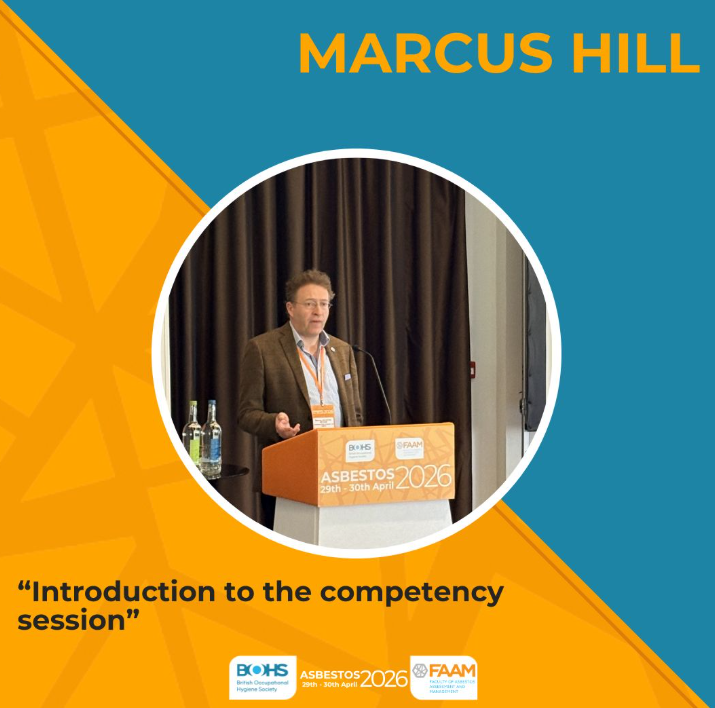
The professional competence session was a central part of day two. Marcus Hill introduced the session, setting out why competence in asbestos consultancy should be understood as more than qualifications, procedures or software systems.
The session brought together practical, behavioural, professional and international perspectives on competence, including discussion of the BOHS Asbestos Surveyors Register, the FAAM Competency Framework and the development of competence frameworks in Australia and New Zealand.
Day One: Health Evidence, Exposure and Emerging Research
The first day of the conference focused heavily on asbestos-related disease, exposure routes and current scientific research. The programme included presentations on asbestos and cancer, the global burden of asbestos disease, upcoming HSE research projects, asbestos in play sand, asbestos in cement water pipes, and the toxicological features of asbestos and asbestos-like mineral fibres.
A recurring theme was that asbestos risk continues to evolve. Historic heavy industrial exposure remains central to the disease burden, but the discussion also considered long-term building occupancy, environmental exposure, consumer products, water infrastructure and naturally occurring mineral fibres.
The conference highlighted that asbestos remains a live public health issue, not simply a legacy problem. Chrysotile, asbestos cement products, ageing building materials and poorly understood exposure routes continue to raise important research and policy questions.
Asbestos, Cancer and the Global Disease Burden
The opening technical sessions considered whether the health consequences of asbestos exposure may be worse than previously understood. Speakers explored disease trends, international data and the continuing impact of asbestos exposure across different populations.
Discussion included changing patterns in mesothelioma and lung cancer, differences between male and female disease trends, and the importance of understanding exposure outside traditional heavy industry. The wider message was clear: asbestos-related disease does not stop when use of asbestos stops. The health legacy continues for decades and remains influenced by how buildings are managed today.
Emerging Exposure Routes and New Areas of Concern
The day one programme also considered less traditional exposure issues, including asbestos in play sand, asbestos in cement water pipes and asbestos-like mineral fibres.
Professor Daniel Murphy’s day one session, Asbestos & Cancer: Is it Worse – Much Worse – Than We Thought?, raised important questions about whether the cancer burden associated with asbestos may be underestimated, particularly in relation to lung cancer and continuing exposure from buildings. His discussion highlighted changing mesothelioma demographics, including the continuing significance of exposure among construction-related trades and building occupants rather than only the traditional heavy industrial groups. A key concern was chrysotile asbestos, which remains widespread in pre-1999 buildings. While chrysotile has often been regarded as lower risk than amphibole asbestos, Professor Murphy discussed research suggesting that, where fibres reach vulnerable tissues, the biological consequences may still be highly significant. He also referred to emerging evidence that chrysotile exposure may be associated with a much larger burden of lung cancer than mesothelioma alone would suggest. The practical message for asbestos management was clear: the presence of asbestos in occupied buildings remains a live public health issue, and building-related exposure should not be treated as a historic or theoretical concern.
These topics demonstrate why asbestos professionals need to remain engaged with current research. The industry cannot assume that all significant exposure routes are already fully understood. New research methods, toxicology, mineral fibre assessment and environmental investigation all have a role in shaping future asbestos policy and risk management.
HSE Research and Technical Development
The conference programme included updates on upcoming HSE research projects and later technical sessions on laboratory performance, AIMS samples and FAAM scientific research activity.
These sessions are important because asbestos management must remain evidence-led. Surveying, analysis, removal, management planning and risk communication all depend on reliable technical information. Continued research helps test assumptions, identify weaknesses and improve standards across the sector.
Day Two: Competence, Ethics and Professional Accountability
Day two opened with a dedicated professional competence session. Marcus Hill introduced the session, which was designed to examine what competence should mean in modern asbestos practice.
The session considered competence from several perspectives, including practical project delivery, behavioural competence in high-risk work, professional registration, the FAAM Competency Framework, and international developments in Australia and New Zealand.
The programme included:
- Introduction to the competence session - Marcus Hill
- A practical aspect - Greg Byrne
- Compliance with a conscience: in high risk work, behavioural competence is the safety system - Richard Bennion
- The BOHS Asbestos Surveyors Register and the FAAM Competency Framework - Kevin Bampton
- FAMANZ: introducing a competency framework in Australia and New Zealand - Brian Eva
- Panel discussion - all speakers
Marcus Hill’s Role in the Competence Session
Marcus developed and hosted the competence session to encourage a more mature discussion about what competence should mean in asbestos consultancy. The aim was to move beyond a narrow view based only on certificates, procedures, accreditation or software systems.
Asbestos consultancy is a judgement-based profession. Surveyors and consultants are often required to interpret incomplete information, understand building construction, define survey scope, recognise limitations, communicate risk and advise clients who may not have the technical knowledge to challenge poor information.
Marcus’s contribution focused on the need for consultants and surveyors to think critically rather than operate as data-entry staff. In modern asbestos surveying, there is a risk that some practitioners are sent from job to job collecting information, with limited involvement in report review, client discussion, project feedback or wider decision-making.
That weak feedback loop matters. If surveyors do not see how their reports are used, and if they are not challenged constructively when information is unclear or incomplete, professional development is restricted and poor practice can become normalised.
The session challenged the industry to ask difficult questions:
- Are asbestos surveyors being trained to think, or simply to collect information?
- Do current systems encourage professional judgement, or suppress it?
- Are consultants given enough feedback to learn from their reports and project outcomes?
- How should individual competence be assessed and maintained?
- What role should ethics, accountability and professional conduct play in asbestos consultancy?
Compliance with a Conscience
A central theme of the competence session was that compliance alone is not enough. In high-risk work, behavioural competence is part of the safety system. Written procedures, checklists and management systems are important, but they cannot replace professional judgement, ethical behaviour and the willingness to challenge unsafe assumptions.
This is especially important in asbestos work because decisions are often made before the risk is visible. A poor survey scope, a vague report, an unchecked assumption or a failure to communicate limitations can all create risk later in a project.
Professional Registers and Competency Frameworks
The session also considered the future of professional recognition in the asbestos sector. The BOHS Asbestos Surveyors Register and FAAM Competency Framework were discussed as part of a wider move towards greater transparency, accountability and continuing professional development.
This is a significant development for clients and duty holders. At present, it can be difficult for non-specialists to know whether a person offering asbestos advice is genuinely competent. A visible professional register, supported by meaningful standards and ethical expectations, could help improve confidence and make it harder for unqualified or unsuitable individuals to operate unchecked.
The FAMANZ contribution added an international perspective, showing that similar questions around competence, professional standards and accountability are being considered in Australia and New Zealand.
The Quality Gap in Asbestos Reporting
One of the wider issues discussed around competence was the quality of asbestos survey reports. Poor reports remain a major weakness in asbestos management.
A report is not merely a record of samples. It should explain what was inspected, what could not be inspected, what was found, what the findings mean, and what action the client should take. Where reports are unclear, generic or poorly scoped, they may fail to support safe decision-making.
This is particularly important for refurbishment, maintenance and construction work. If the scope of works is not understood, or if limitations are not clearly explained, workers may disturb asbestos-containing materials despite a survey having been carried out.
Why This Matters to ARC Clients
Asbestos consultancy is not just a technical exercise. Clients rely on asbestos professionals to understand buildings, interpret incomplete information, explain limitations and provide practical advice before work begins.
This is particularly important during refurbishment, maintenance and construction projects, where poor scoping or unclear reporting can lead to asbestos being disturbed despite a survey having been carried out.
ARC’s approach is based on the same principles discussed during the conference session: clear communication, competent inspection, practical reporting and advice that helps clients make safe, informed decisions.
Ignite Session and Practical Industry Issues
The day two programme also included an ignite session covering a range of practical asbestos topics, including surveying non-traditional housing, generational change, what happens before removal starts, bringing asbestos inspections in-house, NHS asbestos removal projects, asbestos in the supply chain, and REACH in relation to toys.
These short sessions reinforced the diversity of modern asbestos work. The industry is not dealing with one simple problem. It is dealing with buildings, people, procurement, supply chains, public health, regulation, competence and communication.
Policy, Research and Future Direction
The later day two sessions included an HSE update, laboratory research into AIMS samples, and a FAAM scientific research update. Together with the day one programme, these sessions showed an industry that is still developing its evidence base and technical understanding.
At the same time, the competence session showed that technical knowledge alone is not sufficient. The industry also needs professional maturity, ethical responsibility and better ways of helping clients understand what good asbestos advice looks like.
ARC Reflection
For Asbestos Risk Control Ltd, the key message from the conference was that asbestos management depends on both science and judgement.
Research tells us where risks may lie. Regulation tells us what must be done. But competent professionals are still needed to interpret information, apply it to real buildings, communicate clearly with clients and challenge poor assumptions before people are placed at risk.
Marcus Hill’s role in developing and hosting the competence session reflects ARC’s wider position: asbestos consultants should not be reduced to data collectors. They should be skilled professionals who understand buildings, understand risk, understand clients and take responsibility for the quality of the advice they provide.
Better asbestos outcomes require better information, better communication, stronger professional competence and a culture where people are willing to think, challenge and act responsibly.
This interim summary will be reviewed and updated when fuller transcripts and formal conference materials become available.
